The Authentic CEO
Intentionally crafting your role for happiness and longevity
I recently had breakfast with a friend who is a CEO of a startup aiming to double its revenue this year. He told me he needed to start “LinkedIn thought leadership” because he believes it will generate leads, but he’s dreading it because he’s not “the promotional type.” I could see that just the idea of being “that guy” on LinkedIn made his skin crawl. So I shared with him a recent realization that I wish someone had shared with me when I started my entrepreneurial journey:
Design your CEO role to be truly authentic to you.
Your investors, board members, and employees will steer you in all kinds of directions. A CEO in their portfolio landed a whale through a viral LinkedIn post. Another was successful with podcasts and the fireside chat circuit. Or their former boss generated leads through her social media presence. So they expect you to do the same, even if that’s not authentic to you.
Here’s the thing: there is no single founder or CEO archetype.
If you look at any list of the greatest entrepreneurs, you’ll quickly see that there isn’t a “type”. There are the reality-distortion CEOs (Steve Jobs), the quiet CEOs (Daniel Ek), the designer CEOs (Brian Chesky), the scorched-earth hustler CEOs (Travis Kalanick), the engineering nerds (Mark Zuckerberg), the GTM beasts (Marc Benioff), the analytical CEOs (Jeff Bezos), the intuitive types (Sara Blakely), and so on.
Each had a spike and they went all in on it. They didn’t pretend to be someone they’re not. They also had strong founder-market fit, which is just as important as product-market fit. They built a business that is naturally authentic to them. A repeat CEO friend recently told me: “I didn’t start another B2B SaaS company because I never want to run a B2B sales org again. Not my zone.”
So decide what your spike is and commit fully to it. Don’t pretend to be someone you’re not.
This famous 2x2 is a helpful framework by Gay Hendricks:
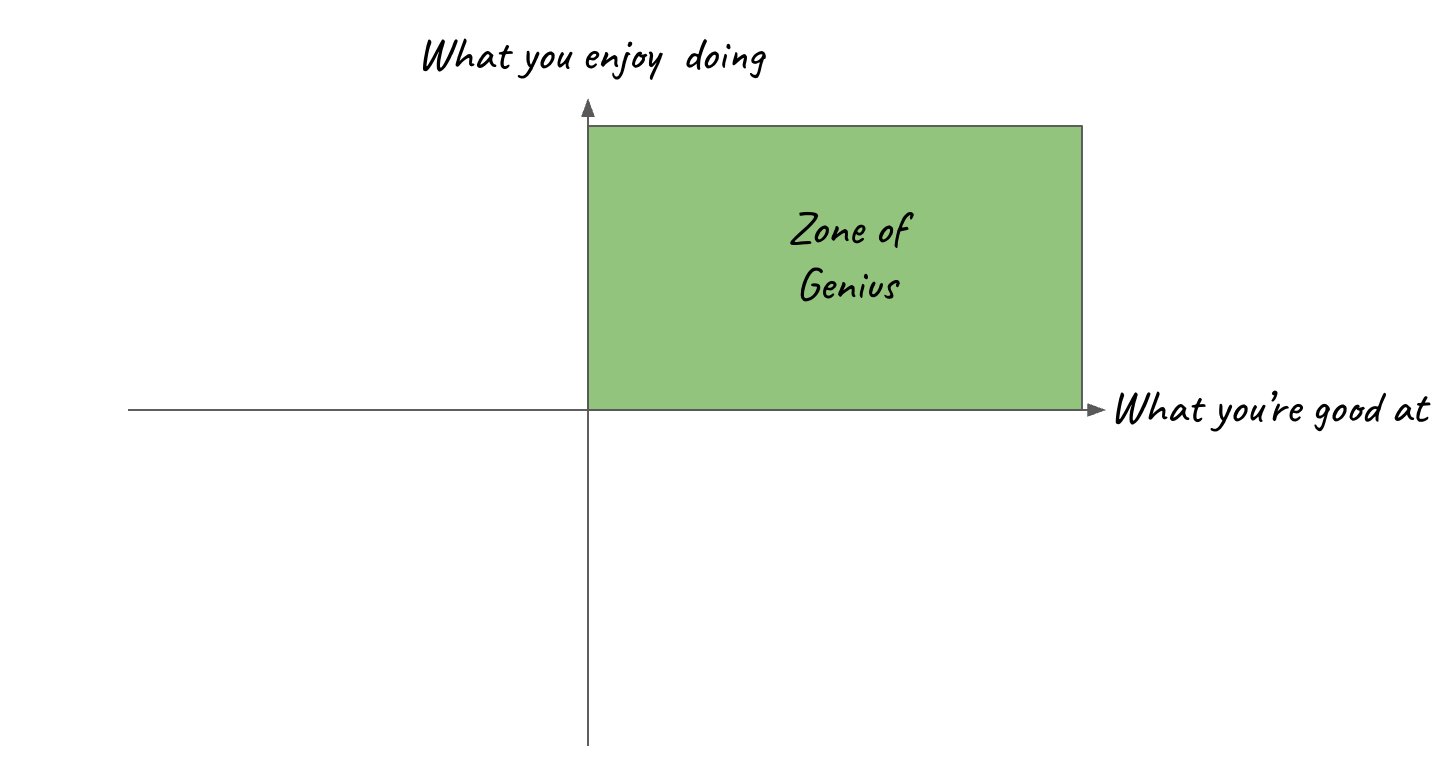
My personal goal is to spend 80% of my time in the zone of genius. There’s always a 20% “tax”. And that’s after 10 years of running Dialogue and ~20 years as an entrepreneur. Obviously, it’s harder earlier in the journey but just being aware of the concept and working towards it can be helpful.
There are certain things a CEO should always do. However, the list is shorter than you might assume. For goodness’ sake, please never delegate responsibilities that specifically require the CEO’s leadership, like announcing a layoff or an acquisition. No matter how much you hate it, you gotta do it. There are other things considered table stakes for a CEO (e.g., setting the strategic vision, attracting top talent, stewarding the culture and values, managing the board), but how you do them is entirely up to you. Again, it must be authentic and natural to you.
Over the years, I delegated or simply eliminated things that fall outside of my zone of genius. My assistant and chief of staff have been hugely helpful in that process. They challenge me every week to let go of things. Some examples:
I used to be the main/sole PR spokesperson, but we now rotate between our team to put the right experts at the forefront. E.g., our Medical Director for health-focused media appearances. He’s more qualified and does a better job at it than me, plus he enjoys the teaching element.
After our IPO, I used to spend more time than I should with analysts, but over time, our CFO and VP of Finance took more and more of these meetings.
I used to run each monthly company all-hands, but now I do it once a quarter during the results review to provide strategic direction. The other two meetings each quarter are run by other members of our senior leadership team.
I do a tiny fraction of the podcasts or panels I am invited to, but share these opportunities with my team, depending on the topic/venue.
One of the happy outcomes of this is that I’ve delegated these activities to colleagues who love them and, frankly, do a better job than me. If you do this with intention and care, you can do a big service to your teammates who are now doing things in their zone of genius.
Building a great business takes a very long time. And you can only do something for a long time if it makes you happy. And one of the keys to happiness is authenticity.
So figure out what the most authentic version of your CEO job is and zone in.
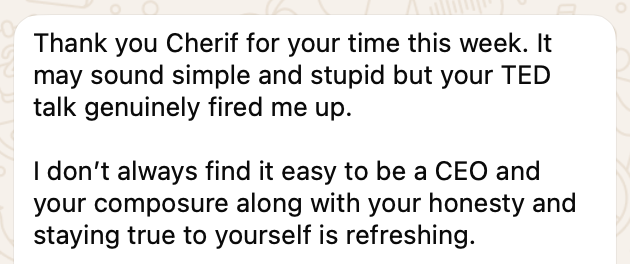
PS: A few days after that breakfast, the CEO in question sent me the text below. I’ll take the “TED talk” comment as a compliment 😎
A big thank you to Allison, Azelie, Eli and Phil for reading drafts of this.
Thoughtful reminder that long-term CEO effectiveness comes from designing the role around your zone of genius and authenticity, not mimicking someone else’s playbook
I love the idea of ‘CEO role authenticity’. It’s easy to think you have to do everything or be like the successful CEOs you admire. But this approach really shifts the focus to doing what works for you and what will help you build your best business. Thanks for sharing this! :)